
 Available in US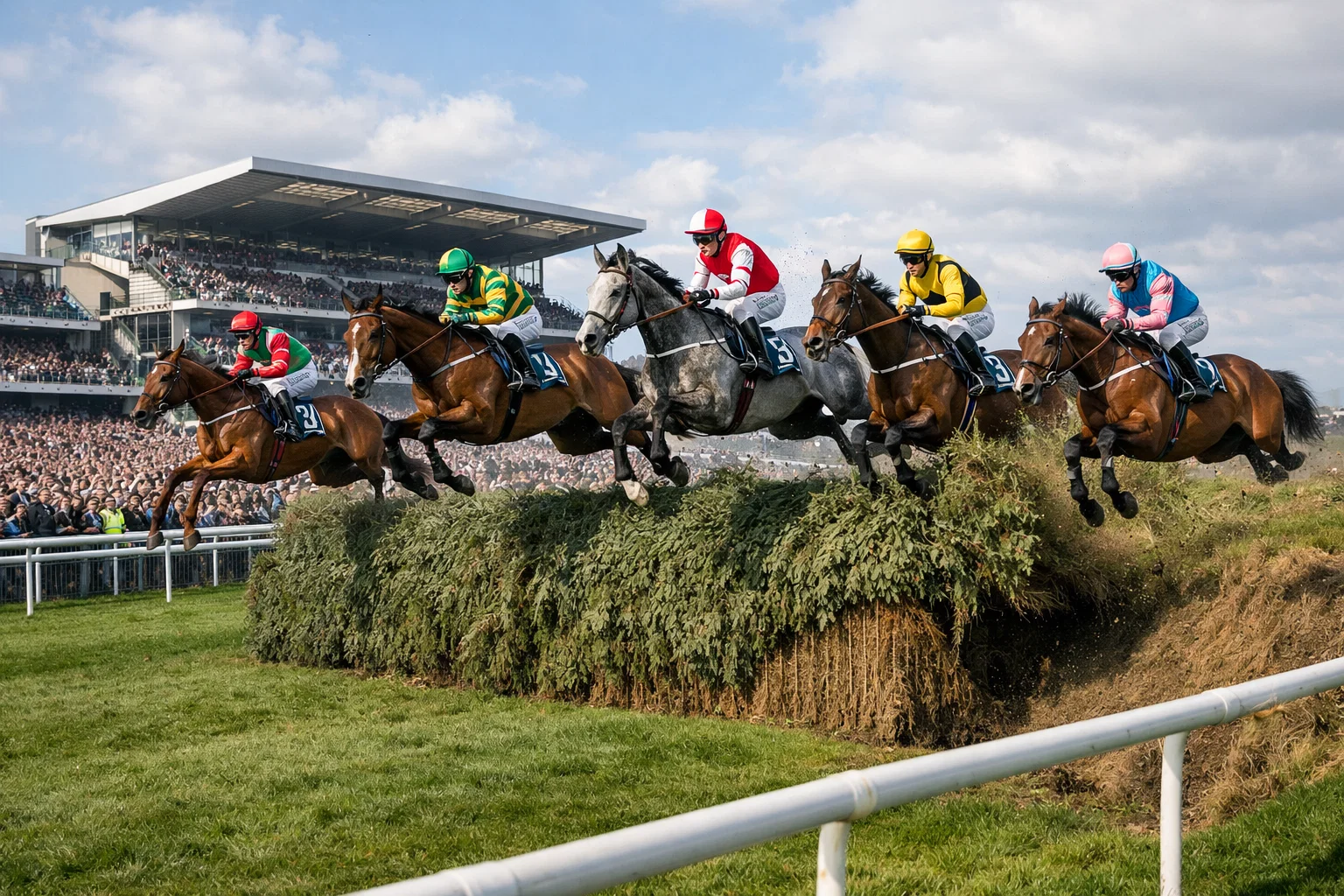
The Grand National stands alone in British sport. No other single race attracts the betting volume, the public attention, or the cultural resonance of those ten minutes at Aintree in April. Office sweepstakes pull in millions who never bet on another race all year. Casual punters become temporary experts on carrying weights and going preferences. For one Saturday, horse racing captures the entire nation’s attention—and the betting industry positions itself to meet that demand.
More than 15% of UK adults bet on horse racing monthly, but Grand National Saturday expands that audience dramatically. The race functions as racing’s shop window, introducing newcomers to the sport through its most accessible narrative: forty horses, thirty fences, four miles of drama, one winner. For regular punters and once-a-year bettors alike, choosing the right app determines whether National day runs smoothly or dissolves into technical frustration. One race. Forty horses. One winner.
Understanding the Grand National
The Grand National’s unique character derives from its exceptional demands. Four miles and two and a half furlongs make it Britain’s longest flat or jumps race; thirty fences—including the legendary Becher’s Brook and The Chair—test jumping ability beyond any other contest. The combination of distance, fence severity, and large fields creates a race where survival matters as much as speed, where stamina trumps class, and where anything can happen.
British racecourse attendance reached 4,799,730 in 2024, with Aintree’s three-day Grand National meeting contributing substantially to that figure. “Horseracing is unique amongst major sports in that we attract customers looking for elite sport and a fantastic social occasion,” noted David Armstrong, CEO of the Racecourse Association. The National embodies this combination—sporting excellence wrapped in public celebration.
The Course and Fences
The Grand National course covers nearly two circuits of Aintree’s National Course, with modifications that make familiar fences look different the second time around. The first circuit includes all thirty National fences; the second circuit omits The Chair and water jump, jumping sixteen fences total. Runners who survive the first circuit face different tactical decisions on the second, knowing precisely what awaits them.
Key fences shape the race. Becher’s Brook, jumped as fence six and twenty-two, features a severe drop on the landing side that catches the unwary. The Canal Turn, at fence eight and twenty-four, requires sharp left-hand navigation immediately after landing. The Chair, the widest and tallest National fence, appears only once but looms largest in runners’ preparation. Each fence has eliminated contenders; understanding which horses handle which obstacles informs selection.
Weight and Handicapping
The National is a handicap, meaning horses carry different weights designed to equalise competition. Top-weighted horses carry 11 stone 10 pounds; bottom weights carry 10 stone. The spread creates a field where class and weight interact—a superior horse carrying heavy weight might find itself disadvantaged against a lesser horse carrying less.
Historically, winners cluster around the 10 stone 7 pounds to 11 stone range. Horses carrying genuine top weights—11 stone 6 pounds or more—rarely win; the combination of extreme distance and weight proves too demanding. Lightweights occasionally triumph but must overcome their relative lack of proven class. The betting market’s job is to price this interaction correctly; the bettor’s opportunity lies in finding horses the market has mis-assessed.
The Modern National
Safety modifications have transformed the Grand National from its most dangerous era. Fence modifications, running rail adjustments, and veterinary oversight reduce—though cannot eliminate—equine risk. The race remains demanding by design, but the worst hazards have been addressed. Completion rates have improved; catastrophic outcomes have become rarer.
These changes affect betting analysis. Horses no longer face quite the same attrition at the notorious fences; form horse quality predicts outcomes more reliably than in previous decades. The National remains a test of stamina and jumping, but pure survival has become less of a lottery. Proper form analysis matters more than it once did.
Best Apps for Grand National Betting
Grand National Saturday presents unique demands: massive concurrent traffic, specific National-focused promotions, and an audience that includes millions of infrequent bettors unfamiliar with app navigation. The best apps handle this combination smoothly; others struggle under conditions they don’t encounter during routine racing.
Grand National Performance Table
| App | National Promotions | Each-Way Terms | Traffic Handling | Ease of Use | Overall Rating |
|---|---|---|---|---|---|
| William Hill | Excellent | Extended places | Strong | Very Good | Excellent |
| Paddy Power | Excellent | Extended places | Strong | Very Good | Excellent |
| Betfred | Excellent | Extended places | Good | Good | Excellent |
| bet365 | Good | Standard+ | Excellent | Very Good | Very Good |
| Coral | Good | Extended places | Good | Very Good | Very Good |
| Ladbrokes | Good | Extended places | Good | Very Good | Very Good |
| Sky Bet | Good | Extended places | Good | Good | Good |
| Betfair | Standard | Exchange terms | Excellent | Complex | Good |
Extended Each-Way Places
Standard industry terms for the Grand National pay four places at 1/4 odds. With forty runners and substantial attrition, competition for fourth place often proves intense. Bookmakers offering extended places—paying five or six places—provide meaningful additional value for each-way punters.
William Hill, Paddy Power, and Betfred traditionally offer the most generous extended place terms, sometimes paying six or seven places. These extensions can transform losing each-way bets into winners: a horse finishing fifth receives nothing under standard terms but place returns under extended promotions. For National each-way betting, place term generosity often matters more than marginal price differences.
Traffic and Reliability
Grand National Saturday generates peak annual traffic for most betting apps. Millions of bets concentrate into the hour before the race; streaming demand peaks as the field approaches the start. Apps that cope gracefully with routine Saturday racing may buckle under National pressure.
bet365 and Paddy Power demonstrate strongest reliability under Grand National conditions based on recent years. Their infrastructure investments assume National-scale traffic; they provision for peak rather than average demand. Smaller operators may experience slowdowns, login difficulties, or settlement delays during the post-race rush. If placing significant National bets, reliability should influence app selection.
New User Experience
Many National bettors use betting apps only once per year. Interface complexity that regular punters navigate automatically becomes barrier for infrequent users. The best National apps make bet placement intuitive: clear market presentation, obvious stake entry, straightforward confirmation. Apps requiring navigation through nested menus or non-obvious UI patterns frustrate casual users.
Grand National Promotions to Look For
The Horserace Betting Levy Board reported levy income of £108.9 million in 2024/25—the fourth consecutive year of growth and the highest figure since 2017’s levy reforms. This revenue, generated from betting activity, reflects the scale of wagering that drives bookmaker promotional competition around flagship events like the Grand National.
Money Back If Your Horse Falls
The Grand National’s fence challenges create falling risk that other races don’t share. “Money back if your horse falls” promotions refund stakes (typically as free bets) if your selection exits the race through fence-related error. Given that several horses fall in most Nationals, this protection carries genuine value.
The promotion’s value depends on your selection profile. Horses with suspect jumping records face higher falling probability; proven National performers with clean jumping histories present lower risk. For selections where jumping represents a question mark, fall protection adds meaningful security. For established safe jumpers, the promotion provides insurance you’re unlikely to need.
Extra Places on the National
Extended place terms represent the most valuable National promotion for each-way punters. Moving from four places to six or seven meaningfully increases place probability in a forty-runner field. The fifth or sixth-place finisher receives nothing under standard terms; under extended places, they generate positive returns.
Different bookmakers offer different extension levels, and these terms can change as National day approaches. Confirming exact place terms before bet placement ensures you’re receiving expected value. Some operators increase extension levels closer to race time; others fix terms weeks in advance. Monitoring promotional evolution helps identify optimal timing for each-way placement.
Enhanced Odds on Favourites
Bookmakers boost prices on National favourites or popular selections to attract new customers. A favourite available at 6/1 might be offered at 10/1 or 12/1 for new sign-ups, with maximum stake limits capping bookmaker exposure. These offers provide genuine value but suit small stakes rather than serious betting positions.
Enhanced odds typically require new customer registration and specify maximum stakes in the £10-£25 range. Existing customers don’t qualify; the promotion targets National-driven sign-ups. If you’re opening a new account specifically for National betting, enhanced odds offers influence which app to choose. The effective value of receiving 10/1 instead of 6/1 on a £20 stake—an additional £80 potential profit—merits attention.
Money Back If Second to Favourite
Some promotions refund stakes if your selection finishes second specifically to the market favourite. This protection suits scenarios where you’re backing a contender you believe can challenge the favourite but might fall short. The favourite’s defeat by another horse doesn’t trigger the refund; only second place behind a winning favourite qualifies.
The value depends on market structure. In Nationals with a clear, short-priced favourite, second-to-favourite protection carries meaningful probability. In wide-open markets without a dominant principal, the specific scenario triggering refund becomes less likely. Assessing market shape before relying on this protection prevents false security.
Grand National Betting Markets
Sports betting constitutes over 56% of all UK online gambling revenue, with horse racing—and the Grand National specifically—generating substantial portions of that activity. The range of National betting markets extends well beyond simple win and each-way options, providing flexibility for varied betting approaches.
Win and Each-Way
The dominant National betting format: back a horse to win, or each-way (to win or place). Standard each-way terms pay four places at 1/4 odds; extended places promotions increase this coverage. For most punters, each-way betting suits National conditions better than win-only given the field size and competitive uncertainty.
Each-way calculation: your stake splits equally between win and place. A £10 each-way bet costs £20 total (£10 win, £10 place). If your horse wins, both portions pay. If it places without winning, only the place portion returns—at 1/4 of the win odds. At 20/1 with 1/4 places, the place return on £10 is £60 (20/4 = 5/1, times £10 stake, plus stake back).
Place Only
Place-only betting removes win ambition entirely, backing a horse solely to finish in the places. Some bookmakers offer place-only markets with adjusted odds; others require each-way bets. Place-only suits confidence in horses that will run well without winning—former winners carrying big weights, consistent performers without quite enough class to triumph.
The odds available for place-only bets typically approximate or slightly undercut each-way place terms. A 20/1 horse each-way pays 5/1 on places; place-only odds might offer 4/1 or 9/2. The slight price reduction reflects guaranteed place-portion activity without requiring bet splitting.
Without Favourite Markets
Without favourite markets remove the market favourite from consideration, paying as if your selection won among the remaining runners. If you believe the favourite won’t stay the trip or won’t handle the fences but lack a clear alternative pick, without favourite betting lets you express that view.
The market creates opportunity when you assess the favourite as overbet. If the market favourite is 5/1, second favourite 8/1, and third favourite 12/1, the without favourite market prices the second favourite as a shorter-priced favourite-equivalent. Backing them without favourite provides better odds than their outright price if the favourite fails.
Forecast and Tricast
Forecasts predict the first two finishers in exact order; tricasts predict the first three. With forty runners and substantial attrition, correctly forecasting National finishing order carries long odds and correspondingly large potential payouts. These markets suit small stakes with lottery-ticket upside rather than serious analytical betting.
Combination forecasts and tricasts allow multiple selections covering different orders. A combination forecast covering three horses requires correctly predicting any two of them in the first two positions—six possible combinations, each at individual forecast odds. Stakes multiply by combination count, increasing cost but improving strike probability.
Special Markets
Novelty markets appear around the National: number of finishers, will specific horses complete, margin of victory, and various proposition bets. These markets carry higher margins than standard win/place betting, compensating bookmakers for pricing unusual outcomes. They suit entertainment value more than serious profit pursuit.
Each-Way Betting on the National
The Grand National’s forty-runner field makes each-way betting almost mandatory for serious participation. Win-only bets on a 25/1 chance require your horse to beat thirty-nine rivals across four miles and thirty fences; each-way extends your interest to include four, five, or six place positions depending on bookmaker terms. The mathematics strongly favour each-way approaches in fields this large.
Understanding Each-Way Value
Each-way value depends on the relationship between win odds, place odds, and place probability. A horse at 20/1 with 1/4 place terms offers 5/1 for places. If you assess that horse as having a 25% chance of placing—not outlandish in a 40-runner field paying four places—the place portion alone represents positive expected value.
The win portion adds additional upside. Even if your horse only wins 3% of the time, that contributes to overall expected value. The each-way combination—modest win probability plus solid place probability—creates positive expectations on selections that win-only betting would find marginal.
Extended Places and Staking
Extended places materially change each-way calculations. Standard four-place terms mean roughly 10% place probability for an average runner (4 places from 40 starters, minus fallers). Six-place terms increase that to approximately 15%; seven places push toward 18%. These probability increases compound with place odds to generate substantially different expected values.
Consider a £20 each-way bet (£40 total) on a 25/1 selection. Win return: £520 (25 × £20 + stake). Place return at 1/4 odds (6.25/1): £145. Under standard four-place terms, your place probability might be 12%. Under six-place terms, perhaps 18%. The expected place value increases by 50%—a meaningful difference that justifies seeking extended place terms.
Optimal Staking Approaches
National staking depends on your risk tolerance and analytical confidence. Conservative approaches spread stakes across multiple each-way selections, accepting that most will lose while hoping one or two hit. Concentrated approaches back fewer horses with larger stakes, requiring higher conviction but offering greater returns when correct.
The each-way structure suits moderate concentration. Three or four each-way selections at meaningful stakes captures the National’s competitive uncertainty while maintaining stake size sufficient for satisfying returns. Backing fifteen horses each-way at minimal stakes almost guarantees hitting a placer but limits any individual return’s significance.
Combining Win and Each-Way
Some punters split their National activity between win-only and each-way bets. A small win-only stake on a longshot provides maximum upside if it wins; a larger each-way stake on a more fancied selection ensures participation across likely scenarios. This combination approach captures different value types without over-committing to either format.
The calculation involves opportunity cost. Every pound on win-only betting could alternatively contribute to each-way place coverage. The win-only allocation suits genuine outsiders at big prices where win probability, though small, exceeds market pricing. Each-way suits more serious contenders where place probability provides primary value.
How to Pick Your National Horse
The Grand National’s unique demands create selection criteria that differ from standard racing analysis. Form matters, but the specific type of form that predicts National success doesn’t map directly onto ordinary handicap chase assessment. Understanding what distinguishes National performers from general chase class helps identify contenders the market might undervalue.
Stamina Above All
Four miles and two furlongs demands genuine staying power. Horses that weaken after three miles won’t survive the National’s final circuit. Previous success over extended distances—three miles or more, preferably over demanding tracks like Haydock or Kelso—indicates the stamina the National demands. Horses whose best form comes at shorter trips face serious questions.
The second-circuit demands particularly punish the merely adequate stayer. After three miles of effort, still facing the Canal Turn, Valentine’s, and the run-in hill, horses must find reserves they’ve never needed before. Previous marathon experience—the Welsh National, the Midlands National, the Eider Chase—provides the most relevant preparation.
Jumping Reliability
National fences forgive less than standard chase obstacles. Horses that make occasional errors elsewhere may find those tendencies punished severely over thirty National fences. Clean jumping records over long trips suggest the reliability the National demands; horses prone to unforced errors at smaller fences face heightened risk.
Previous Aintree experience provides the most direct jumping evidence. Horses that have completed the National course—whether in the National itself or the supporting Topham Chase or Grand Sefton—have demonstrated they can handle the specific obstacles. First-time National runners without Aintree experience carry uncertainty that proven course performers don’t.
Weight and Age
National winners cluster in specific weight and age ranges. Horses aged nine to eleven win most frequently; younger horses lack experience, older ones lose stamina. Weight-wise, winners typically carry between 10 stone 7 pounds and 11 stone 4 pounds. Genuine top-weighted horses rarely prevail; extreme lightweights occasionally win but must overcome their relative lack of proven quality.
These patterns don’t eliminate horses outside optimal ranges—exceptions occur—but they identify where probability concentrates. A nine-year-old carrying 10 stone 12 pounds fits the profile; a seven-year-old carrying 11 stone 9 pounds faces historical headwinds regardless of their apparent ability.
Trainer and Jockey Record
Certain trainers excel at National preparation. Their horses arrive race-fit, targeted specifically at Aintree, with jumping tuned for National obstacles. Past National success from a stable indicates preparatory capability that transfers across runners. First-time National trainers may prepare perfectly, but they’re unproven in ways established National specialists aren’t.
Jockey experience matters over thirty unique fences. Riders who know the course—who understand where to sit, when to push, how to approach the drop fences—hold advantages over talented jockeys experiencing the National for the first time. Previous National rides, even on horses that failed, provide education that first-timers lack.
Recent Form vs Class
The market often overvalues recent winners while undervaluing class performers in patchy form. A horse winning a modest race last time out might price shorter than a graded performer returning from a disappointing run. For the National, class and past achievement often predict better than recent results—the race rewards quality that surfaces under unique pressure.
Our Top 3 Grand National Apps
The Grand National’s unique demands—massive traffic, infrequent users, specific promotional needs—favour certain apps over others. Three excel for National Saturday betting.
William Hill
William Hill’s heritage in racing translates into Grand National expertise. The brand has paid out on National bets for decades; their understanding of what National punters need shapes their product. Extended place terms, money-back promotions, and straightforward betting interfaces combine into a National-optimised experience.
The shop network provides additional value for National day. Bets placed via the app can be settled at physical locations, avoiding post-race settlement queues and providing human assistance if questions arise. For punters who value in-person service alongside digital convenience, William Hill’s hybrid model delivers.
Reliability under National traffic holds strong. William Hill’s infrastructure handles the annual surge without visible degradation—no login failures, no bet placement delays, no streaming interruptions during the race itself. This basic competence, surprisingly uncommon under extreme load, matters most when stakes are highest.
Paddy Power
Paddy Power approaches the Grand National as a promotional showcase. Money-back offers, enhanced odds, extra places, and National-specific specials proliferate across the meeting. The promotional creativity that defines the brand reaches maximum intensity for racing’s highest-profile day.
Beyond promotions, the app handles National betting smoothly. Market presentation clarifies forty-runner fields without overwhelming; each-way placement requires minimal navigation; price changes reflect live market movements accurately. The interface suits both experienced punters placing considered bets and casual users backing office sweepstake selections.
Streaming quality and reliability match promotional generosity. The National itself streams in HD without buffering; supporting races across the three-day meeting receive equivalent coverage. For punters watching via app rather than television, Paddy Power provides viewing quality that enhances rather than detracts from the experience.
Betfred
Betfred’s identity centres on National Hunt racing generally and the Grand National specifically. The brand sponsors major National Hunt fixtures; racing forms its core business rather than secondary product line. This commitment translates into National expertise that multi-sport operators can struggle to match.
Extended place terms frequently lead the market. Betfred’s willingness to pay six or seven places when competitors offer four or five reflects their understanding of National each-way dynamics. For punters prioritising place term generosity above all else, Betfred often provides the most favourable conditions.
The promotional approach emphasises substance over flash. Money back offers, BOG protection, and loyalty rewards deliver genuine value without requiring attention-seeking marketing. For punters who prefer straightforward racing-focused betting over entertainmentised sportsbook experiences, Betfred’s traditional approach resonates.
Grand National Betting Apps — More on this topic at horse racing betting apps.
See also Articles.
